
This isn’t about any one company. It’s a pattern I’ve seen across the industry, and one most engineers will recognize.
Organizations hire engineers to move them forward.
- Engineers are hired to improve systems.
- Architects are hired to prepare for growth.
- Security professionals are hired to find weaknesses and help close them.
Yet in some workplaces, those same people discover something frustrating.
Identifying the problem is easy.
Getting a decision to solve it is hard.
The proposal is technically sound. The replacement is ready. The need is understood.
And progress still stops at approval.
The reason usually sounds responsible:
“We can’t afford to break anything.”
And that concern deserves respect. Production supports customers, employees, revenue and operations. Protecting it is part of the job.
But when “protect production” becomes the reason to postpone every necessary improvement, it’s worth asking what we are actually protecting.
Stability has value.
So does the ability to evolve.
The Comfort of Leaving Things Alone #
“If we change nothing, nothing will break.”
It’s an appealing idea. It feels like control.
The system works today. People understand it. There is no migration to explain and no deployment to defend.
But the world around that system keeps moving.
- The business grows.
- Dependencies age.
- Security requirements evolve.
- Workarounds multiply.
What was fine for a small company becomes a constraint for a larger one.
It shows up in different forms:
- An aging system keeps running while its replacement waits for the right window.
- A fast-growing environment keeps adding scale while a foundational capability stays on the “later” list.
There can be valid reasons for both. Budget, staffing, dependencies and business timing all matter.
The problem starts when those reasons never turn into a plan with an owner and a date.
From a distance, everything looks stable.
Inside the engineering team, more energy is going into preserving the present than preparing for what’s next.
Ask Questions That Move the Work Forward #
A growing company doesn’t need to experiment recklessly in production to innovate.
It needs a clear way to decide whether a change is ready.
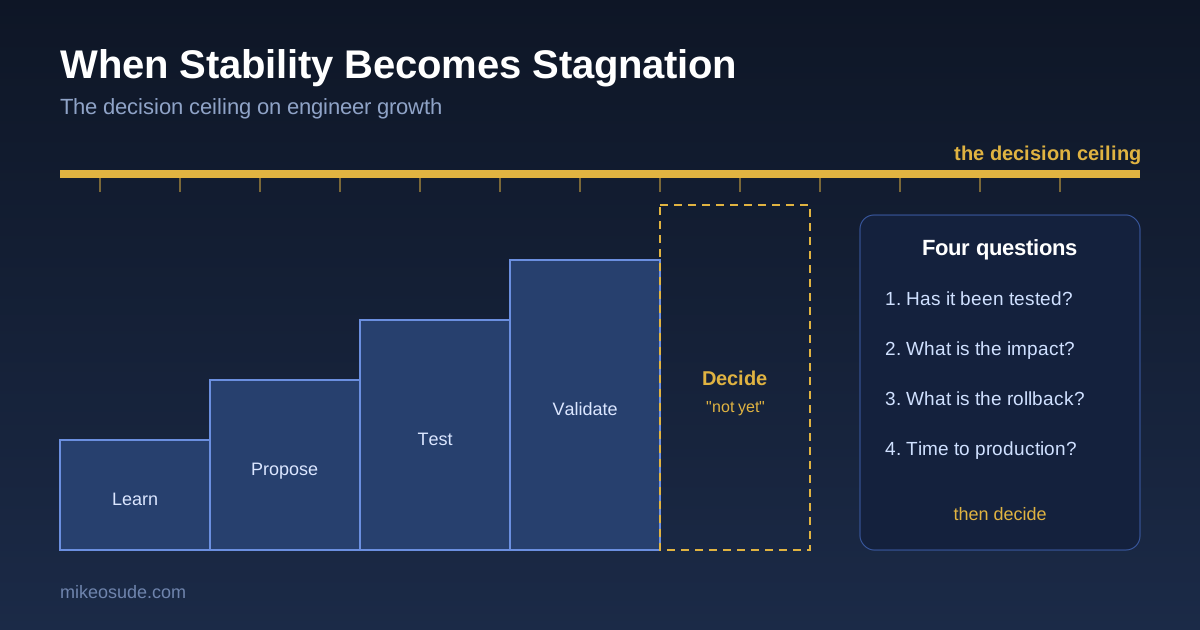
Four questions do most of the work:
- Has it been tested? What’s the evidence, and how close was the test to the real environment?
- What is the impact? Which users, services and dependencies are affected, and what disruption should we expect?
- What is the rollback plan? If it doesn’t behave, how do we restore service?
- What is the time to production? What remains, who owns it, and when does it happen?
These questions give caution a purpose.
They turn uncertainty into work that can be finished and reviewed.
“What if it breaks?” is a good way to start an assessment.
It should lead to testing, mitigation and a decision.
When it ends the conversation every time, caution has quietly become paralysis.
Once a solution has been designed, tested and validated, with its impact understood and its recovery plan in place, continued delay needs an explanation.
- If it isn’t ready, name the gap.
- If something blocks it, name the blocker.
- If the business is choosing to accept the risk, make that decision explicit and set a date to review it.
Any of those is a decision.
An indefinite “not yet” is not.
The Decision Ceiling #
A company can only grow as fast as it can decide.
You can hire strong engineers, buy the right tools and write excellent proposals. If good evidence doesn’t turn into timely decisions, that is the ceiling.
I don’t think leaders need to know how to configure every firewall, build a certificate authority or write every automation. That’s why we hire specialists.
What leaders do need is judgment:
- Ask useful questions
- Weigh the evidence
- Understand the business impact
- Recognize the limits of their own expertise
- Give qualified people a path to execute
The best leaders I’ve worked with are comfortable saying, “I don’t fully understand this part. Walk me through it.”
That sentence has unlocked more progress than any amount of pretending.
Nobody can be an expert in everything, and nobody should have to be. The risk appears when the decision process has no way to bridge that gap, so every improvement waits on a single point of approval.
Then the company has the technical capability to move forward and lacks a decision path to use it.
That’s a process problem, not a people problem. Processes can be fixed.
What Repeated Delay Teaches Your People #
Culture isn’t what’s written on the wall.
It’s what happens after someone raises a concern or proposes an improvement.
When well-supported proposals keep stalling, people notice. They learn:
- How much effort it takes to get a decision
- Whose judgment is trusted
- Whether initiative leads to progress or just more frustration
Then they adapt.
- Some stop proposing improvements.
- Some get very good at maintaining workarounds.
- Some leave, because they want to build somewhere their work reaches production.
And the organization wonders why innovation slowed down.
Nobody decided to teach that lesson. It’s what the process taught anyway: changing nothing is the safest career move.
This is where it becomes a growth and development issue.
Engineers grow by shipping. By seeing an idea survive testing, face review, reach production and teach them something real.
An engineer whose proposals never get a decision stops growing, no matter how much training budget they have.
So the responsibility runs both ways.
Engineers must bring clear evidence, a realistic impact assessment and a workable plan.
Leaders must evaluate that work and give a decision.
A proposal left permanently unresolved is a miss for both sides, and a shared one.
Measure Stability Alongside Progress #
Uptime matters. Reliable operations matter.
But a good quarter should also make us ask what we improved.
- Did we reduce a known weakness?
- Did a tested solution reach production?
- Did we remove a recurring manual burden?
- Is the environment better prepared for growth than three months ago?
- How long has our oldest approved-but-unshipped change been waiting?
That last one is worth tracking.
Time to production tells you whether an organization can turn capability into results.
Speed isn’t the goal.
A clear path from proposal, to testing, to decision, to implementation is.
Innovation involves uncertainty. Mature engineering reduces that uncertainty before production and manages what remains.
Leadership makes responsible progress possible by making sure evidence leads to a decision.
Final Thoughts #
I’m not arguing against caution.
I’m arguing against caution with no end date.
Protect production. Test thoroughly. Plan the rollback.
Then decide.
Because there is no progress in stagnation, and the people doing the work can tell the difference.
So here are the questions I’d leave you with:
- Where does protecting stability become protecting stagnation?
- How long should a tested solution wait before the delay itself needs scrutiny?
- What does your workplace teach people when they try to improve something that already works?