
From WordPress to Hugo: Removing the Bloat and Embracing Simplicity #
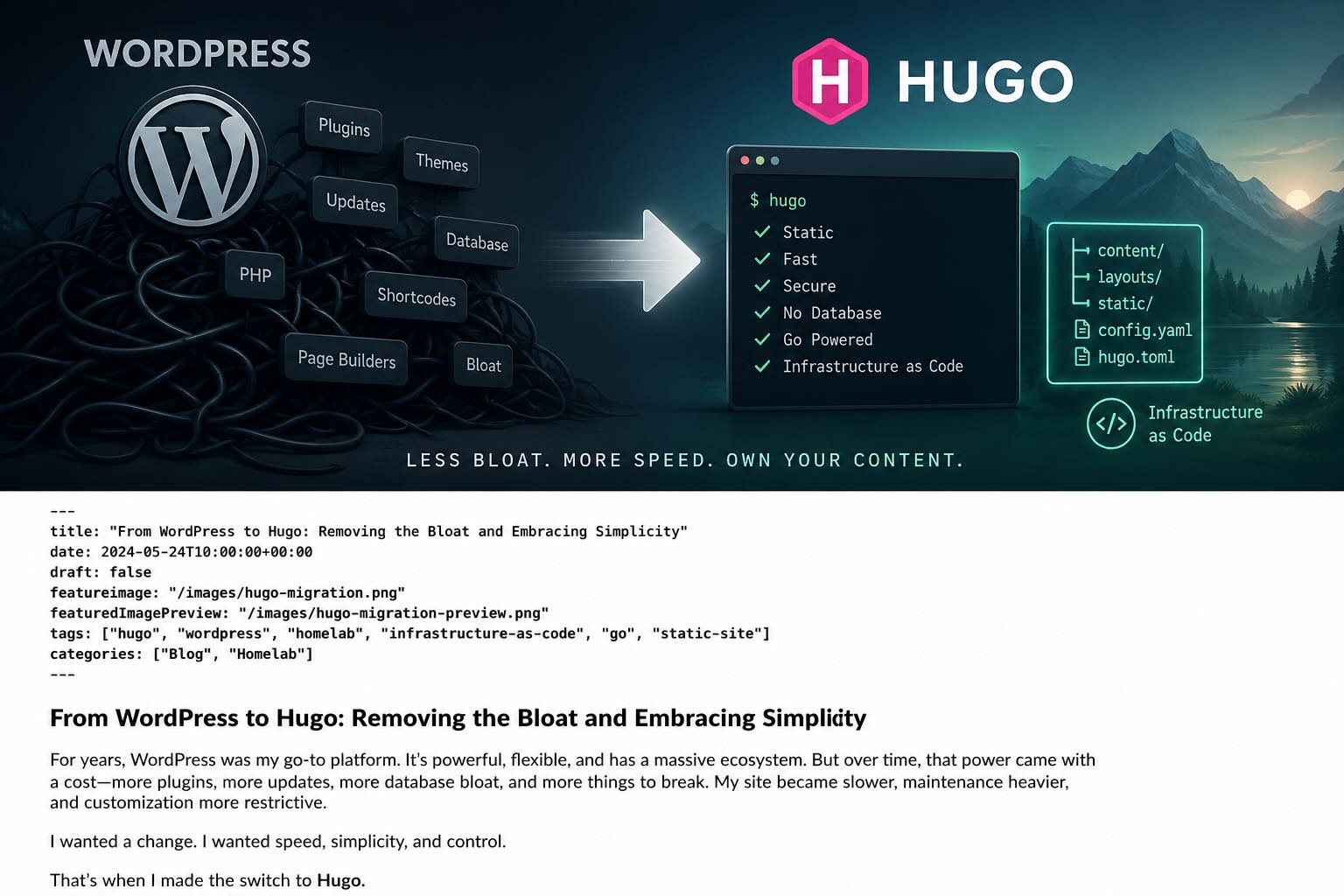
What started as a simple blog eventually turned into something heavier than it needed to be.
I wanted something different. Something faster, cleaner, and more aligned with how I already operate my homelab.
That is when I moved to Hugo.
⸻
The Problem with WordPress (In My Context) #
WordPress is not inherently bad—it is simply not optimized for the way I think about infrastructure anymore.
In my environment, everything is moving toward:
- Declarative configuration
- Version-controlled infrastructure
- Minimal runtime dependencies
- Predictable deployments
WordPress, by design, conflicts with that model:
- Requires a database (stateful, harder to manage as code)
- Relies heavily on plugins (introducing drift and inconsistency)
- Needs constant patching and maintenance
- Encourages UI-driven changes instead of code-driven ones
It became clear that WordPress did not align with my Infrastructure as Code approach.
⸻
Why Hugo Made Sense #
Hugo immediately stood out because of its simplicity and design philosophy.
It is:
- Written in Go (fast, compiled, portable)
- A static site generator (no runtime backend required)
- File-based (everything lives in Git)
- Extremely fast to build and deploy
From an engineering standpoint, this is exactly what I wanted.
Instead of managing a running application, I am now generating static content that can be served anywhere—NGINX, object storage, CDN, or even directly from a container.
⸻
The Shift to Infrastructure as Code #
This was the biggest win.
With Hugo:
- My entire website is just a Git repository
- Content is Markdown
- Configuration is YAML/TOML
- Themes are versioned
- Deployments are automated
This means:
- I can track every change
- I can roll back instantly
- I can replicate environments easily
- I can integrate directly into CI/CD pipelines
The website is no longer “a system I maintain”—it is just another artifact built from code.
That aligns perfectly with how I already manage:
- Kubernetes manifests
- Terraform configurations
- Ansible playbooks
Hugo fits naturally into that ecosystem.
⸻
Performance and Simplicity #
Another major benefit is performance.
With WordPress:
- Every request hits PHP
- Queries a database
- Loads plugins
- Renders dynamically
With Hugo:
- Pages are pre-built
- Served as static files
- No processing required at runtime
The result is:
- Near-instant page loads
- Lower resource usage
- No backend attack surface
- No scaling concerns
It is simply faster and more efficient.
⸻
What I Gained #
After the migration, the improvements were immediate:
- No more plugin maintenance
- No database backups to worry about
- No patch cycles for CMS vulnerabilities
- Faster deployments
- Cleaner architecture
More importantly, I gained consistency.
My blog now behaves like the rest of my infrastructure.
⸻
Final Thoughts #
Moving from WordPress to Hugo was less about changing tools and more about aligning philosophy.
I am standardizing everything around:
- Simplicity
- Speed
- Reproducibility
- Infrastructure as Code
Hugo delivers on all of those.
If your environment is already leaning toward automation and declarative systems, continuing to run a traditional CMS like WordPress starts to feel out of place.
Hugo removes that friction.
And once you make the switch, there is no going back.